

The private market is far larger than the part most teams can search. The best targets are often founder-led, bootstrapped, cross-border, or off-market — exactly the companies traditional databases tend to miss. This article looks at how M&A teams are making that hidden market searchable.
Most of the market is private. In the US, 87% of companies with over $100 million in revenue are privately held. Globally, fewer than 50,000 companies are publicly listed — a tiny fraction of the businesses that exist.
For M&A teams, the best targets are often even harder to see. Many have never raised outside capital, rarely appear in the usual databases, and leave only scattered signals across websites, filings, local sources, and industry networks.
That is why finding the right company has often been the hardest part of the deal. As Joseph Milstein, founder of Gamma Point Advisory, puts it: the challenge is not doing deals, but finding the right people to talk to.
This article looks at how M&A teams are changing that search.

The companies that don't show up
The gap starts with coverage. Traditional databases are built around companies that raise capital, file publicly, and carry clean industry codes — which leaves the founder-led, the bootstrapped, and the international firms in shadow, exactly where many of the best targets sit.
Carlos Cesta ran into that wall while running makanta services, a cross-border advisory. He had used platforms such as PitchBook and S&P Capital IQ, but they broke down when the search moved beyond large, well-documented companies. Across Germany, Italy, and France, the independent IT and marketing firms he needed to find barely registered because they had never raised outside capital.
Across Germany, Italy, and France, the independent IT and marketing firms he needed to find barely registered because they had never raised outside capital.
Finding them required a different starting point. Instead of searching only within the companies already visible in traditional databases, Carlos could expand from known examples and narrow the results with signals such as technology partnerships, client mentions, founder backgrounds, and geography.
“Discovery was the bottleneck, and Inven solved it,” Carlos says. “I could finally pinpoint the small, high-potential companies that traditional tools kept missing.”
For a boutique advisory, that reach changed the business itself. “Being small, we can be global thanks to Inven. Even after moving from the U.S. to Rome, I could walk into client meetings with credible, data-backed insights.”
“Being small, we can be global thanks to Inven. Even after moving from the U.S. to Rome, I could walk into client meetings with credible, data-backed insights.”
Ben Rapaport, co-founder of the independent sponsor Edgehill Management, describes the same gap from the buyer's seat.
Screening 25,000 companies across verticals, he kept turning up businesses he had not seen anywhere else. "I don't know what the secret sauce is," he says, "but there are definitely names that showed up on Inven that didn't show up on other platforms."
That coverage let Edgehill follow the data out of its first idea, HVAC, and into life sciences, where it closed its first acquisition 8 months faster than the median.
Mapping the market
Finding companies is one job; understanding how a market is built is another. This is where sourcing turns into something broader.
Andrew Guest, an analyst at the UK growth investor Imbiba, uses Inven to map subsectors no database had mapped before, luxury travel operators among them, and the arithmetic of his week changed. "In a typical three-hour session, I'll find 15–20 companies to contact," he says. "Before Inven, I would have been lucky to find four."
The mapping reaches past sourcing into financial screening and commercial due diligence, too. Imbiba uses Inven’s private-company financials to check balance sheets, revenue estimates, and direct links to official Companies House filings without jumping between sources. When the firm weighed a consumer-product investment, Guest exported a list of relevant venue operators so a colleague could approach them directly and test demand, validating the strategy before the firm committed a pound.
Imbiba uses Inven’s private-company financials to check balance sheets, revenue estimates, and direct links to official Companies House filings without jumping between sources.
At Chelsea Corporate, a London buy-side advisory, a market map turned into a transaction. Managing director Ran Carmon used Inven to map a sector for an international client and surfaced a food manufacturer in the north of England turning over around £50M; the cross-border deal closed at the end of the year. "With Inven, we are finding at least 40% more targets with exactly the same time and resources," he says.

Rebuilding the research itself
For some teams the change runs deeper than any single search. It reaches the whole research process behind a recommendation.
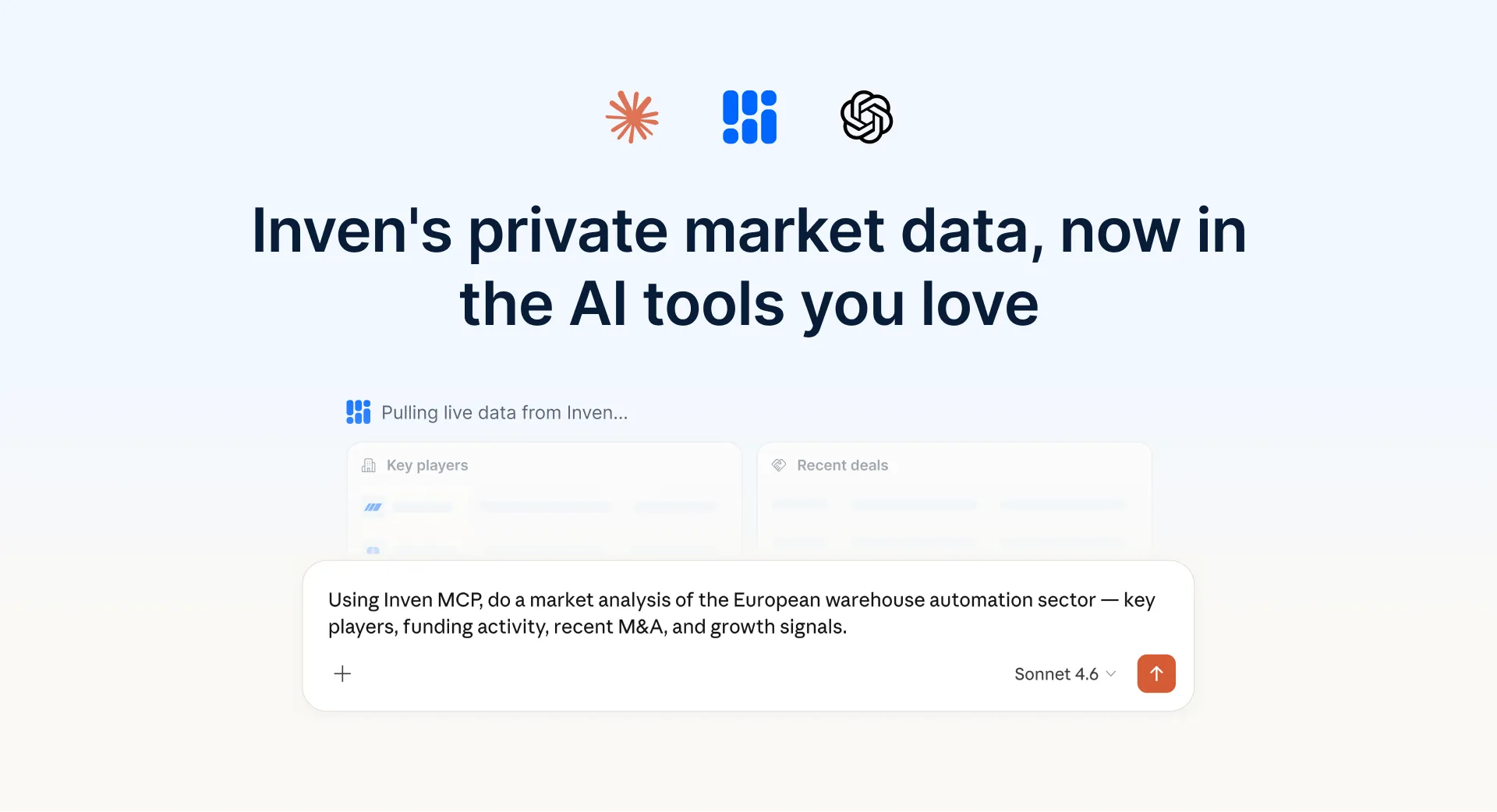
Dustin Engel, co-founder of the strategy firm Elegant Disruption, rebuilt his research workflow around Inven's data connected through MCP to his own client knowledge and AI tools.
Competitive landscapes and acquisition theses that once took weeks now take an afternoon, and to him the bigger change is that they hold up. The frustration he set out to fix was never speed but rework: "You build something that works, then you can't fully reproduce it next time." Now, he says, "everything is iterative and traceable. The output is better, and more importantly, it's repeatable."
Building the buyer universe
Not every mandate is a hunt for targets. On the sell side, the job inverts: find the buyers, and find all of them.
Kirk Michie, a 30-year M&A veteran, runs advisory Candor Advisors with a lean team and a sell-side focus. On a single fintech mandate, Inven helped him assemble the kind of buyer universe usually reserved for firms with far more headcount. "We were able to add roughly 50 potential buyers, both strategic and financial," he says. "The AI-driven search was pivotal in refining our buyer list."
For GaP Advisors, a Houston investment bank, the bar is exhaustiveness. "The worst feeling for any investment banker is being asked why a specific company is not on the list," says director Raul Rizo-Patron. Starting from 100 strategic buyers and filtering by title, his team built a shortlist of 20 qualified buyers, each with verified decision-maker contacts, in about 10 minutes.
At IGC Partners, a mid-market investment bank, the wider reach turns up on the bottom line: the firm finds three times as many qualified buyers and prepares lists in half the time. "Inven doesn't just make us faster," says partner Rafael Frugis. "It helps us grow revenue by finding buyers we wouldn't reach otherwise."
Reaching the right people
Joseph Milstein built Gamma Point Advisory around logistics, a sector where the right conversation can sit several layers away from any obvious database result. Within months of using Inven, he had reached executives across three continents and signed an NDA with the CEO of a $330M-revenue logistics company — progress he credits to finding the right decision-makers faster, not to the tool closing anything for him.
He draws that line himself. “Inven doesn’t sell the deal for me,” he says. “But it removes the hardest part: finding the right people.”
That is a narrower claim than most software makes. Inven does not replace judgment, outreach, or trust. It makes the slowest part of the work faster, so dealmakers can spend more time on the part only people can do.

The deals that wouldn't exist otherwise
Craig McNally and Kamran Cheema run Desert Horizon Capital, a search fund built on proprietary, off-market deals — the hardest channel of all to run, because no public signal tells you which owner is quietly ready to sell. They tested Inven head-to-head against the tool they were already using, and switched. "There are a lot of companies that Inven has which other platforms don't," McNally says. Cheema points to one feature in particular: the intent-to-sell signal, which surfaces owners thinking about retiring or moving on, before they ever call a broker.
Two years in, that channel has produced more than 100 owner conversations and three of the firm's 10 signed LOIs, all off-market. "Without a service like Inven," McNally says, "we wouldn't be finding these companies."
Inven completely opens up the proprietary off-market world for us.”
— Craig McNally, Managing Partner, Desert Horizon Capital
What they share
A search fund and a private equity firm have little in common on paper; neither does a boutique in Rome and a consultancy rebuilding its research stack. What connects them is the realization that they could no longer afford to work from a partial view of the market.
The same theme appears in reviews from teams that never end up in a case study. One user describes Inven as “like having a team of analysts working beneath you, leaving you more time to scrutinize the output.” Another says it simply “eliminates hours of tedious manual research.”
Whether the job is sourcing targets, mapping a market, preparing diligence, or building a buyer list, the question underneath is the same: which companies should you be talking to, and how do you reach them before everyone else?
For the overwhelming majority of the market, which sits in private hands, that question used to be hard to answer. Now, more of it is searchable.

See what Inven surfaces in your market. Book a demo and explore your vertical with us.
Figures and customer quotes are drawn from Inven customer case studies and verified G2 reviews. Market-size references are based on industry datasets and public sources, including the World Bank, the World Federation of Exchanges, the European Commission, and S&P Capital IQ.
See the full private market
1,000+ M&A teams use Inven to find the companies others miss.
Join 1,000+ M&A teams using Inven to map markets faster, find the companies others miss, and build defensible outputs across 28M+ companies.

%20(1)-2.jpg)