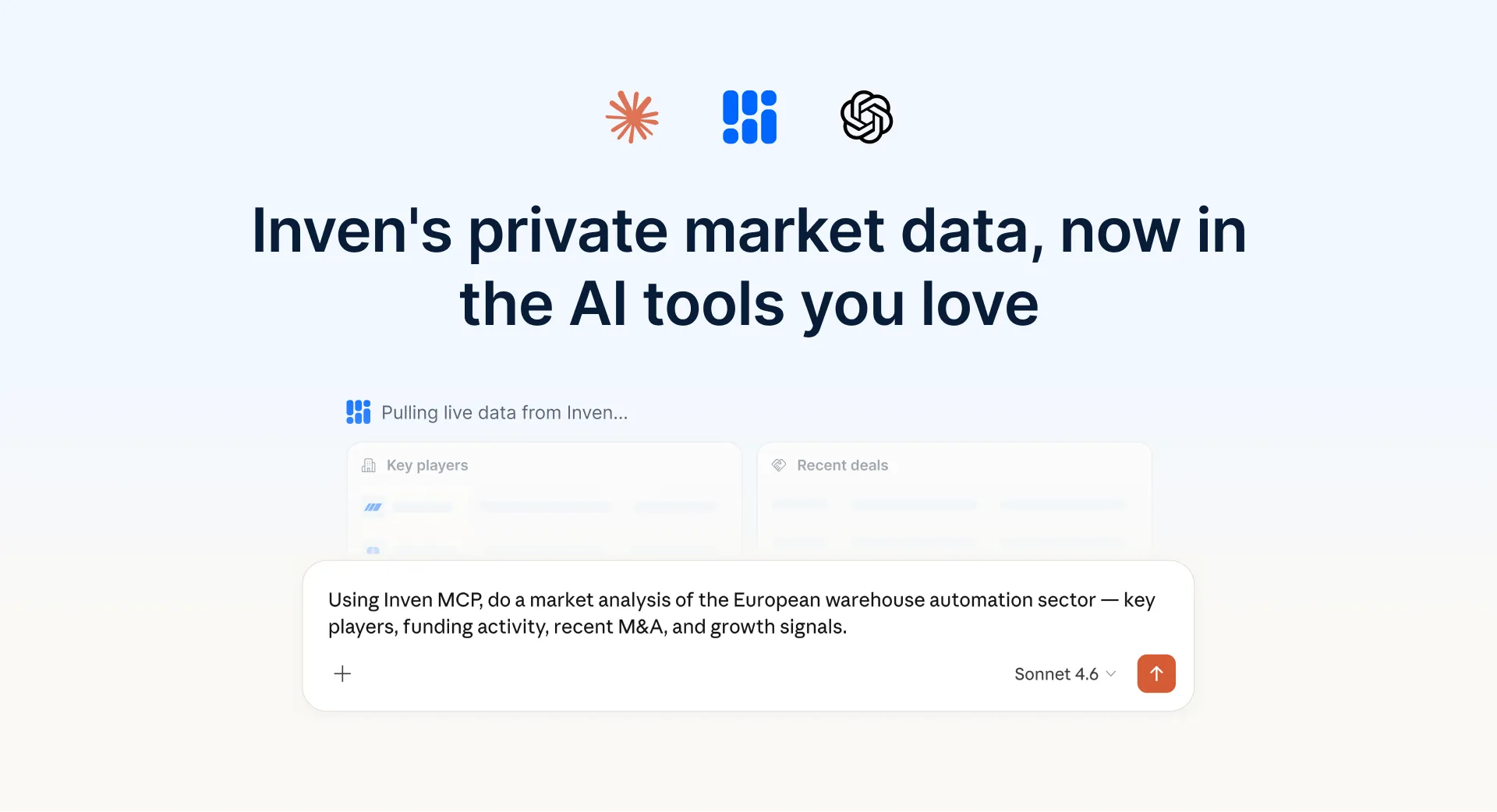

Inven is the M&A research tool that works with Claude in 2026. None of Inven's native work requires Claude at all.
How does Inven work with Claude?
Inven works with Claude through MCP, the Model Context Protocol. MCP lets Claude connect to external data sources and tools, including Inven.
Claude gives you another place to work with the data. Inven provides the private market data, M&A-specific search, and source-linked outputs behind it.
When Inven is connected to Claude, Claude can query live Inven data during your workflow. That means you can use Claude to summarize, analyze, and write based on company data from Inven, instead of relying only on Claude's general knowledge or files you manually upload. Inven is the source Claude connects to.
What Inven is
Inven combines proprietary company data with M&A-specific search, enrichment, and analysis. It covers 28M+ companies, most of them private, across firmographics, financials, ownership, people, and intent to sell signals.
The data is structured so M&A teams can search, filter, compare, and defend what they find.
This matters because most M&A questions are specific. A general AI tool can describe a market, but without live company data, it cannot reliably build a defensible target universe. It cannot tell you which logistics software companies in DACH grew headcount last year, show verified decision-maker contacts, and link each data point back to source.
A general AI cannot tell you which logistics software companies in DACH grew headcount last year, show verified decision-maker contacts, and link each data point back to source.
Inven can, because that data exists inside Inven.
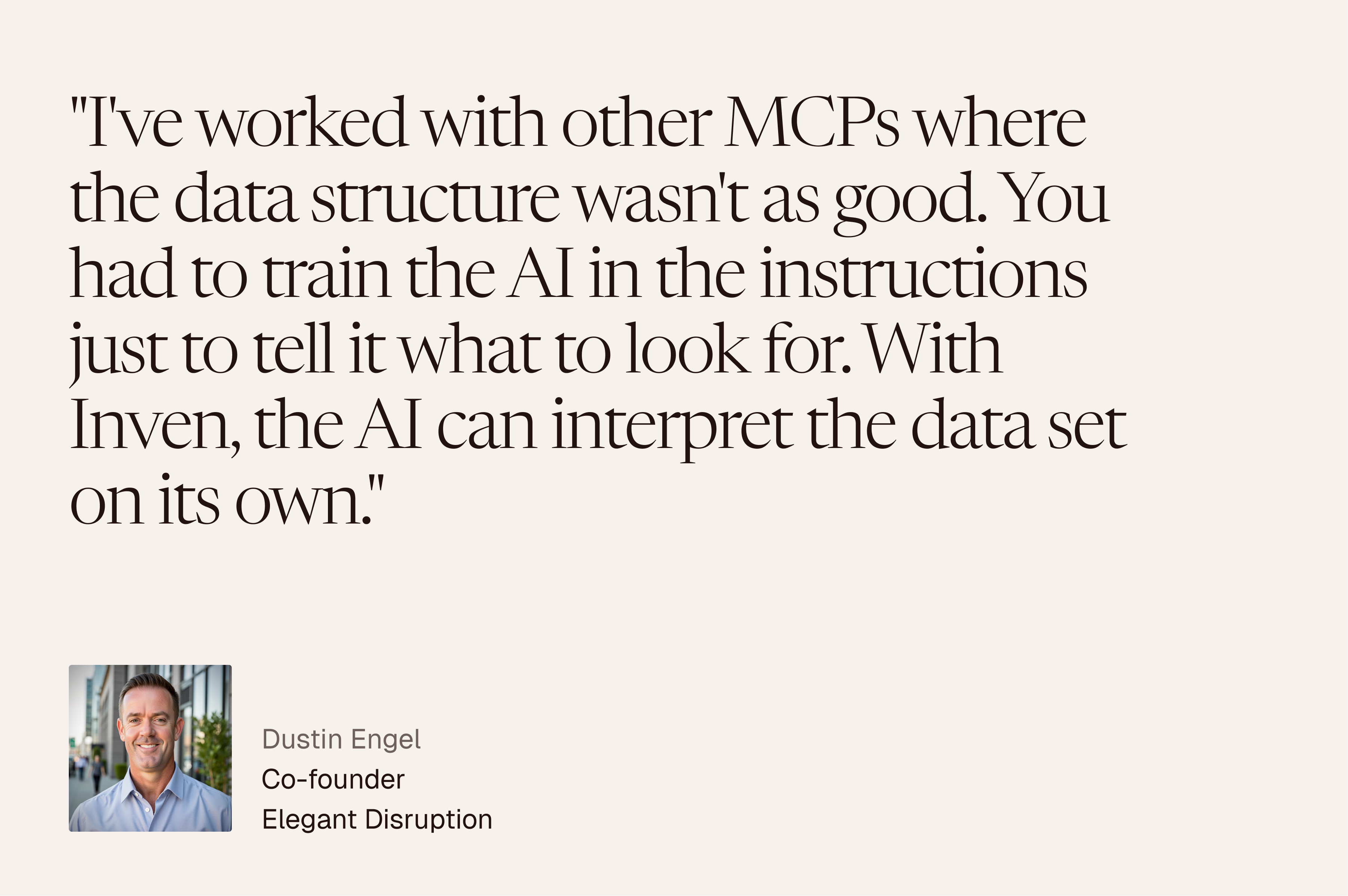
Elegant Disruption, a strategy and M&A advisory firm, connects Inven to its AI workflow through MCP. For co-founder Dustin Engel, the difference came down to how the data is structured: "I've worked with other MCPs where the data structure wasn't as good. You had to train the AI in the instructions just to tell it what to look for. With Inven, the AI can interpret the data set on its own."
What Claude adds
Claude is useful when an M&A team already works in Claude and wants to combine Inven data with its own context.
Through MCP, Claude can use Inven data alongside uploaded documents, CRM exports, interview notes, internal research, or other company-specific material. This makes it useful for written outputs that depend on more than company data alone, such as structured memos, market summaries, investment rationale, or internal research notes.
Inven provides the proprietary company data, source links, and M&A-specific retrieval. Claude gives teams another place to work with that data, especially when it needs to be combined with internal material already used in their AI workflow.
What is Inven's MCP?
Inven's MCP is the connection between Inven and compatible AI tools such as Claude, ChatGPT, and Cursor.
MCP stands for Model Context Protocol. It is an open standard that allows AI tools to connect to external data and tools. Through Inven's MCP, Claude can query Inven's company data directly.
For M&A teams, this means Inven can act as a live data layer inside Claude. Instead of asking Claude to work from general knowledge, you can give it access to structured private market data from Inven.
Eight Quarter Advisors, a lower middle market M&A advisory firm, uses Inven for faster buyer lists, better company research, and finding the right people in one workflow. As associate Kaden Bowker puts it, "building a buyer list used to take me about a week. With Inven, I can do it in a day or less." With Inven MCP, that workflow now extends into the AI tools the team already uses.
Why the data matters
The value of Inven does not come from a model alone. It comes from what the model can access. Inven is an applied AI company, not a foundation-model company: it builds its own M&A search and data, and uses the best available models to work with it.
Inven is built on proprietary company data, source-linked financials, ownership structures, decision-maker data, and M&A-specific retrieval. That is what makes the output defensible.
Without Inven, Claude can still reason, summarize, and write. But it does not have Inven's private company data on its own. With Inven connected through MCP, Claude can work from live company data across private markets.
"Inven gives my AI workflow what it was missing: structured data, traceability, and a result I can defend."
— Dustin Engel, Co-founder, Elegant Disruption
When to use Inven directly
Use Inven directly when you need to build, validate, or refine company data. That includes:
- Building longlists and shortlists
- Enriching company lists with AI
- Searching private companies by industry, geography, ownership, financials, or growth signals
- Looking up revenue, EBITDA, ownership, descriptions, and decision-makers
- Comparing large data sets
- Saving lists, sharing work, and leaving notes with your team
Inven is built for the parts of M&A research where structure matters: lists, filters, fields, sources, and repeatable analysis at scale.
When to use Inven with Claude
Use Inven with Claude when you need to combine Inven data with other sources or turn the data into analysis. That includes:
- Combining Inven lists with internal documents
- Reviewing CRM exports alongside market data
- Summarizing interview notes against company data
- Running multi-step research workflows inside Claude
For large company universes, the best workflow is usually:
- Build and validate the list in Inven
- Save the curated set
- Use Claude through MCP to turn the Inven data into written output, combined with uploaded documents, CRM data, interview notes, or other internal material
This is especially useful when the starting universe is large, such as 10,000–30,000 companies. Inven handles the company data and filtering. Claude helps turn the curated set into analysis.
What M&A teams can do with Inven and Claude
With Inven connected to Claude, teams can run workflows such as:
- Company research: one-pagers, business model summaries, ownership reviews, competitor views, and financial history
- Valuation work: public peer sets, precedent transaction analysis, and supporting commentary
- Market analysis: bottom-up sizing, segmentation, competitive landscapes, and M&A activity
- Deal sourcing: buyer lists, target screening, acquisition universes, and outreach
The point is not to replace Inven with Claude. It is to let Claude work with Inven data when synthesis, writing, and cross-source analysis are useful.
How Eight Quarter Advisors uses Inven MCP with Claude
Eight Quarter Advisors uses Inven to build buyer lists, find relevant companies and decision-makers, and move from research to outreach faster. By connecting Inven to Claude through MCP, the team can bring Inven’s proprietary private market data directly into the AI workflows it already uses.
“Of everything I’ve tested, Inven integrates best with tools like Claude. Our research is faster as a result, and more importantly, better.”
— Kaden Bowker, Associate at Eight Quarter Advisors
The speed difference is significant. According to Bowker, building a buyer list, identifying the right people, and finding their contact details would normally take about a week. With Inven’s AI-driven workflow, the team can complete the same work in a day or less.
The MCP setup also stood out compared with other platforms the firm uses:
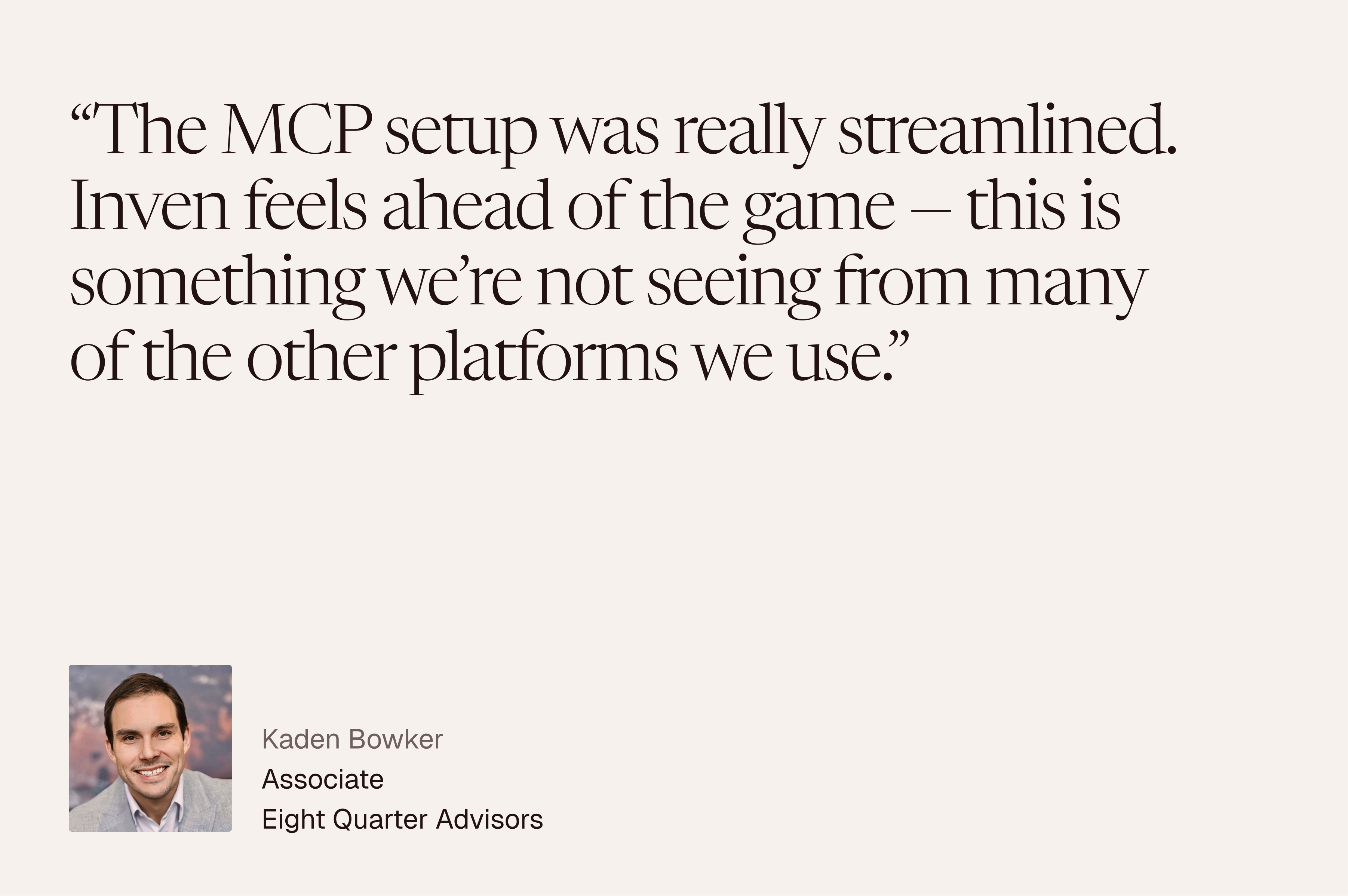
“The MCP setup was really streamlined. Inven feels ahead of the game — this is something we’re not seeing from many of the other platforms we use.”
For Bowker, the value is not simply that the workflow is faster. It is that Claude can work with structured, M&A-specific data rather than relying on general knowledge alone.
“If you work in M&A and are building AI into your workflow, Inven is worth a look", Kaden concludes.

Common questions
What is the difference between Inven and Claude?
Claude is a general-purpose AI tool. Inven is AI for M&A, built on proprietary company data, search, filtering, retrieval, and enrichment. Founded in 2022, Inven is the first AI for M&A and is used in the daily workflow of bulge bracket banks, MBB firms, PE funds, and corporate development teams. Through MCP, Claude can connect to Inven and use Inven data in your workflow. Claude on its own does not have Inven's data.
Does Claude have access to Inven data by default?
No. Claude does not have access to Inven data by default. Claude can access Inven data when Inven is connected through MCP. Once connected, Claude can query live Inven data as part of your workflow.
What is Inven's MCP?
Inven's MCP lets compatible AI tools query live Inven data. Tools like Claude, ChatGPT, and Cursor can use Inven as a data source inside AI workflows. For M&A teams, this means company lists, financials, ownership data, decision-maker data, and other Inven data can be used directly inside Claude.
Is Inven built on Claude?
No. Inven is not built on Claude. At Inven's core is its own search model, which the team began building before large language models became widely available, purpose-built to read an M&A brief and find matching companies in Inven's data. Inven is model-agnostic: Claude is one of the AI tools that can connect to it through MCP, not the engine underneath it. What makes Inven valuable is its proprietary data, that M&A-specific search, and structured, source-linked outputs.
Which LLM does Inven use?
Inven is an applied AI company, not a foundation-model company. It does not build a general-purpose model from scratch. Inven's own search model, which predates the current wave of LLMs, does the company-finding, and Inven uses the best available models to handle language and interpretation. It is model-agnostic and not dependent on one provider. The core value is Inven's proprietary data and the M&A-specific search built around it. The model helps process the work; the data is what makes the output traceable and defensible.
Can I use Inven with ChatGPT as well as Claude?
Yes. Inven's MCP can connect to compatible AI tools, including Claude, ChatGPT, and Cursor. The workflow is similar: Inven provides the company data, and the AI tool gives you a place to analyze, summarize, or write with that data.
See how it works
Bring your own market, mandate, or target universe. We'll show what Inven can find, structure, and bring into your AI workflow. Book a demo.
See the full private market
1,000+ M&A teams use Inven to find the companies others miss.

Join 1,000+ M&A teams using Inven analyze entire markets and build polished deliverables — backed by private market data.
Frequently asked questions
Which M&A research tools work with Claude?
Inven, through its MCP connection and Skills. Any other database could in principle connect the same way, but it would need to expose a comparable MCP interface, and most tools covering middle-market and private companies have not built one.
What is the difference between Inven and Claude?
They are different categories of product. Inven is an M&A research platform with its own data on 28M+ private and public companies; Claude is a general-purpose assistant that owns no company data. Connected, one supplies the facts and the other does the reading and writing.
What is the difference between Inven Workflows and Inven Skills?
Where they run. Workflows are saved research tasks that execute entirely inside Inven, with no Claude involved. Skills live inside Claude, in Cowork and Code but not Chat, and their job is narrower: keeping Claude's output in the firm's format when it works with Inven data.
Does Claude have access to Inven data by default?
No. Out of the box, Claude knows only what it learned in training. It reaches Inven data only after an Inven customer sets up the MCP connection or installs the plugin.
What is Inven's MCP?
The connection standard through which Claude, ChatGPT, and Cursor query live Inven company data. It moves data; it does not decide what to do with it. The workflows sit in Inven or in the Skills on the Claude side.
Is Inven built on Claude?
No. Inven was founded in 2022 and built its own company search model before the current wave of LLMs arrived. Today more than 1,000 teams (Inven, August 2026) across bulge-bracket banks, MBB consultancies, private equity funds, and corporate development groups use the platform, none of which depends on Claude.
Which LLM does Inven use?
Inven is model-agnostic. Its own search model handles company discovery, and the platform is not tied to any single LLM vendor, so it works with whichever assistant your team connects, or with none.
Can I use Inven with ChatGPT as well as Claude?
Yes. ChatGPT and Cursor connect through exactly the same MCP interface, so a team standardized on either gets the same live access to Inven data. See the integrations page for the current list.
Lorem ipsum dolor sit amet, consectetur adipiscing elit, sed do eiusmod tempor incididunt ut labore et dolore magna aliqua. Ut enim ad minim veniam, quis nostrud exercitation ullamco laboris nisi ut aliquip ex ea commodo consequat. Duis aute irure dolor in reprehenderit in voluptate velit esse cillum dolore eu fugiat nulla pariatur.