
Find comparable companies by matching business, size, and geography, then pull trading comps. Use similar completed deals for paid multiples.
Last updated August 2026.
You find comparable companies by matching the target on what it sells, how it makes money, how large it is, where it operates, and how fast it is growing, then screening for those traits in a database that can actually see them. For listed peers with full financials, that means Capital IQ or Bloomberg. For private peers, an example-company search in Inven screens across 28M+ companies (Inven product data, August 2026). For the multiples buyers actually paid, you pull similar completed deals rather than trading peers, which is what Inven's Deal Search is for.
One distinction before the process. Comparable company analysis benchmarks the target against similar businesses and reads trading multiples off them. Precedent transactions benchmark it against similar completed deals and read off the multiples paid. Most valuation work uses both, and the rest of this page covers how to build each set: choosing the peers, where the data lives, how to get a multiple you can source, and the mistakes that quietly move the final number.
For the transaction side, see Find Private Market Deal Data with Inven's Deal Search and the broader workflow in Find Private Market Deal Data.
How does comparable company analysis work in practice?
Comparable company analysis values a target by lining it up against companies that share its sector, product, size, growth, and financial profile, then reading trading multiples such as EV/EBITDA across the group. If the target trades or would trade well above the peer range, you have a case that it is expensive. Below the range, cheap. Inside it, fairly priced.
Everything rests on the group you picked. The peers form the comparable universe, and if that universe is wrong, the multiple you read off it is decoration.
Why does the peer set matter?
Because the multiple only means something if the businesses behind it face the same economics as the target. The comps should share industry, market segment, geography, products and services, business model, and growth stage. Slip one wrong name into the set, say a peer with a different geography, distribution channel, and end market, and it drags the median toward a business the target does not resemble. The output still looks like a valuation. It just values the wrong company.
How do you choose comparable companies for accurate valuation?
Match the target on product or service, business model, size, geography, growth stage, and data availability. The last one is easy to forget: a company that mirrors the target perfectly but publishes no usable financials gives you nothing to compute a multiple from, and a peer in a different market skews the result even when its numbers are pristine. Investopedia's CCA overview covers the same ground; here is the working checklist.
- Product or service. Future growth is tied to demand for what the company sells. Peers from unrelated industries carry different risk, regulation, and competitive pressure, so their multiples price different things.
- Business model. Companies that make money the same way tend to have similar cost structures and economics, which is what makes their multiples transferable.
- Size. Compare on revenues, market share, and industry influence. Because public companies have the most available data, comp sets drift toward listed names that are larger than the target. Be aware of the drift even when you accept it.
- Geography. Compare Western European companies to other Western European companies, US names to US names. Different markets price the same business differently.
- Growth rate. Peers should sit at similar growth stages. A mature business and a scaling one deserve different multiples even in the same industry.
- Data availability. A great lookalike is a poor comp if there is nothing to base the analysis on. This is the practical reason comp sets are so often built from publicly traded companies.
Which tools do you use to find comparable companies?
Traditional databases such as Bloomberg and Capital IQ are the right place for public financials. Inven is the right place when the set needs private companies, because its example-company search screens across 28M+ companies (Inven product data, August 2026), and its Deal Search covers precedent transactions. In short:
| Tool | Job in valuation | When it fits |
|---|---|---|
| Inven | Example-company search for the comp set across 28M+ companies; Deal Search for precedents; source-linked outputs | Private-market CCA plus precedents, not only listed trading comps |
| Capital IQ / Bloomberg | Public financials, ratios, and historical statements | Listed trading comps and filings |
| PitchBook | Transaction, valuation, and investor records | Deal history sitting next to the peer set |
Traditional methods: business databases, websites, and news
Bloomberg and Capital IQ hold financial statements, ratios, stock prices, and industry classifications, and you can supplement them with public records; see how to find company information. They are widely used and their data is consistent, which is why every trading comp ends up sourced from one of them. The trade-offs are cost and the way search works: access is expensive, and screening can still be limited to fixed industry codes, which describe what a company is registered as rather than what it does. Keep the terminals for listed financials. What they do not do is start from an example company and surface private peers that resemble it, which is the part Inven handles.
AI search for comparable companies
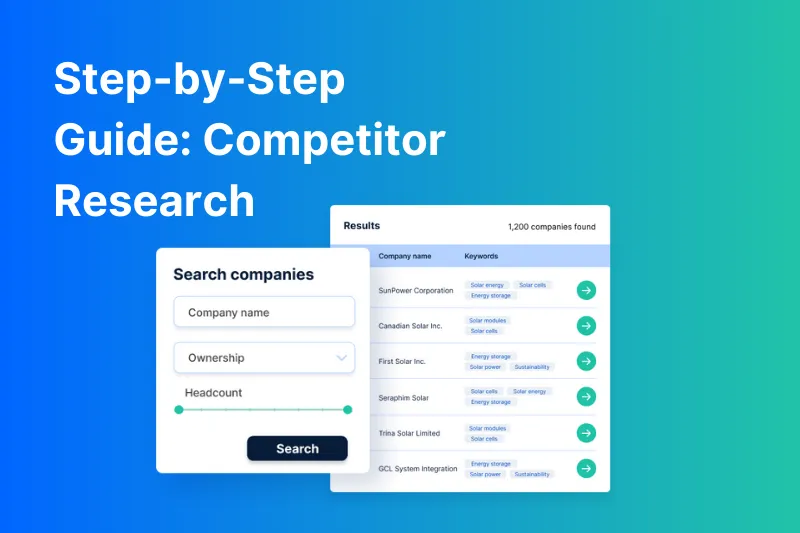
Inven aggregates data from company websites, industry registries, and other sources, covering 28M+ companies including public ones. The workflow starts from a single example company: you enter the target, Inven returns companies that match its business, and you narrow the list by location, headcount, business model, and ownership. Reach for it when the peer set must include private companies that match what the target actually does, and stay on Capital IQ or Bloomberg when you need listed statements. There is a comparison of options in best competitor analysis tools.
Why quality information matters
A comp set is only as good as the universe it was drawn from. If relevant companies never appeared in the search, the comparison is incomplete and nobody in the room will know. Work from up-to-date sources and use the filters, location, headcount, business model, and ownership, to make sure the names that survive the screen actually belong there.
How do you find comparable companies with Inven?
Set the target as an example company, filter by location, headcount, and ownership, and run the screen across 28M+ companies. Then categorize the list, export it, and use the ownership filter together with Deal Search to surface acquisition activity. Step by step:
1. Identify the company for valuation
Before touching any tool, understand the target's business model, target market, and competitive landscape. The screen can only be as precise as your read of what the company does.
2. Select the right criteria
Set the target as the example company and apply filters for location, headcount, and ownership. If the analysis needs full financials, filter to public companies so the results come with enough data. Narrow the activity keywords until they describe the business rather than the sector, then run the screen with the AI screener.
3. Search companies with similar business models
The peers do not always need to sell the exact same product. If the target manufactures aluminum sheets, manufacturers of other heavy industrial products may qualify, provided they match on the remaining criteria. You can reduce the weight of individual keywords so the loosest matches drop out of the results.
4. Categorize the companies
Split the output into closest peers and names with potential from slightly different sectors. Export both lists. The second group is worth keeping: it feeds the sanity check when the core set turns out thin.
5. Find acquisition information through the ownership filter
Filter to PE-backed companies in the same industry. Those names come with acquisition news and recent valuation data attached, which is the bridge from the trading comp set into precedent territory.
How do you find precedent transactions and source-linked multiples?
Search for similar completed deals, meaning acquisitions, mergers, and funding rounds, and use the multiples that were actually paid. These are not trading comps and should not be blended with them silently. Inven's Deal Search covers 1M+ private market transactions gathered from press releases, firm websites, and filings, and Inven analyzes over 4 million news sources, websites, and transaction databases to build that record. Each deal ties back to an enriched company profile with ownership, revenue estimates, headcount, and transaction history.
The source link is the point. When a multiple goes into a memo or a deck, someone will eventually ask where it came from, and "a database said so" is not an answer. A deal record that traces to its press release or filing is.
For a product walkthrough, see Deal Search; for the wider workflow, Find Private Market Deal Data.
What mistakes skew comparable company analysis?
The usual failures are mixed geographies, too few peers, unadjusted special items or accounting standards, peers picked by industry code instead of by what the companies actually do, and blending trading comps with precedent multiples nobody can source. In detail:
- Including companies from non-comparable areas. Valuations in China are not comparable with the US; the same business commands different multiples in different markets.
- Not taking enough companies to the list. A set of three peers means one outlier moves the median, and the answer becomes an accident of selection. A broader screen protects against this (Inven).
- Not adjusting for special items in income statements. One-off gains and charges distort the earnings base under the multiple.
- Not adjusting for different accounting standards. IFRS and FAS treat items differently enough that EBIT and EBITDA need adjusting before peers on different standards can share a table.
- Using generic industry codes instead of NLP-based understanding of what companies do. Codes capture registration, not reality, and they miss the businesses that sit between categories.
- Mixing trading comps and precedent transactions without saying so, or using a deal multiple whose source you cannot show. Paid multiples carry control premiums that trading multiples do not; label which is which.
What else should you read after the comps set is chosen?
Once the peers and precedents are chosen, the remaining work is the multiple math, and that follows a standard CCA method. This page's job was finding the right companies and deals; for the mechanics, Investopedia's CCA entry covers the calculation, and Joshua Pearl and Joshua Rosenbaum's Investment Banking: Valuation, LBOs, M&A, and IPOs is the standard reference for the full workflow.
If the comp set itself is the bottleneck, this is what Inven is built for. It generates PowerPoint output directly: company one-pagers and overview slides in your firm's own template, plus saved M&A workflows, all drawn from data Inven owns on 28M+ companies rather than licensed PitchBook, Capital IQ, or FactSet feeds. On this page the workflow that matters is building the peer set through example-company search and pulling precedent transactions through Deal Search, with every deal linked to its source. Keep Capital IQ or Bloomberg for listed financials, ratios, and historical statements, and keep PitchBook for deal history alongside the peer set; Inven does not replace those terminals. Over 1,000+ teams use it for the sourcing and screening work in front of them (Inven, August 2026). Book a demo.
See the full private market
1,000+ M&A teams use Inven to find the companies others miss.

Join 1,000+ M&A teams using Inven analyze entire markets and build polished deliverables — backed by private market data.
Frequently asked questions
How do you find comparable companies and precedent transactions?
Two searches, two databases' worth of logic. Comparables come from screening on business traits: start from the target's product, business model, size, geography, and growth stage, and screen in Capital IQ or Bloomberg for listed names or in Inven, from an example company, when private peers belong in the set. Precedent transactions come from deal records instead of company records: search completed acquisitions, mergers, and funding rounds involving similar businesses, which is what Deal Search does across 1M+ private market transactions.
What is the difference between comparable companies and precedent transactions?
Comparable companies tell you what the market pays to hold a similar business; precedent transactions tell you what an acquirer paid to own one. Trading multiples move with the market every day and reflect minority stakes. Deal multiples are fixed at signing and usually include a control premium, so they run higher. Use comps for where a business should trade and precedents for what a buyer might pay, and never present one as the other.
Where does Inven's deal data come from?
From primary sources rather than a licensed feed: press releases, firm websites, and filings, drawn from the 4 million-plus news sources, websites, and transaction databases Inven analyzes. Each deal is attached to the company's enriched profile and keeps its link back to the original source, so when a multiple ends up in a document, the person reading it can follow the trail to where the number was first reported.
Does Inven replace Capital IQ or Bloomberg for comps?
No, and it is not trying to. The terminals remain the right source for listed financials, ratios, and historical statements, which is where trading multiples for public peers come from. Inven covers what the terminals structurally miss: finding private companies that resemble an example company, and sourcing private-market deal data. On most mandates the two sit side by side, Inven building the set and the terminal pricing the listed half of it.
Lorem ipsum dolor sit amet, consectetur adipiscing elit, sed do eiusmod tempor incididunt ut labore et dolore magna aliqua. Ut enim ad minim veniam, quis nostrud exercitation ullamco laboris nisi ut aliquip ex ea commodo consequat. Duis aute irure dolor in reprehenderit in voluptate velit esse cillum dolore eu fugiat nulla pariatur.