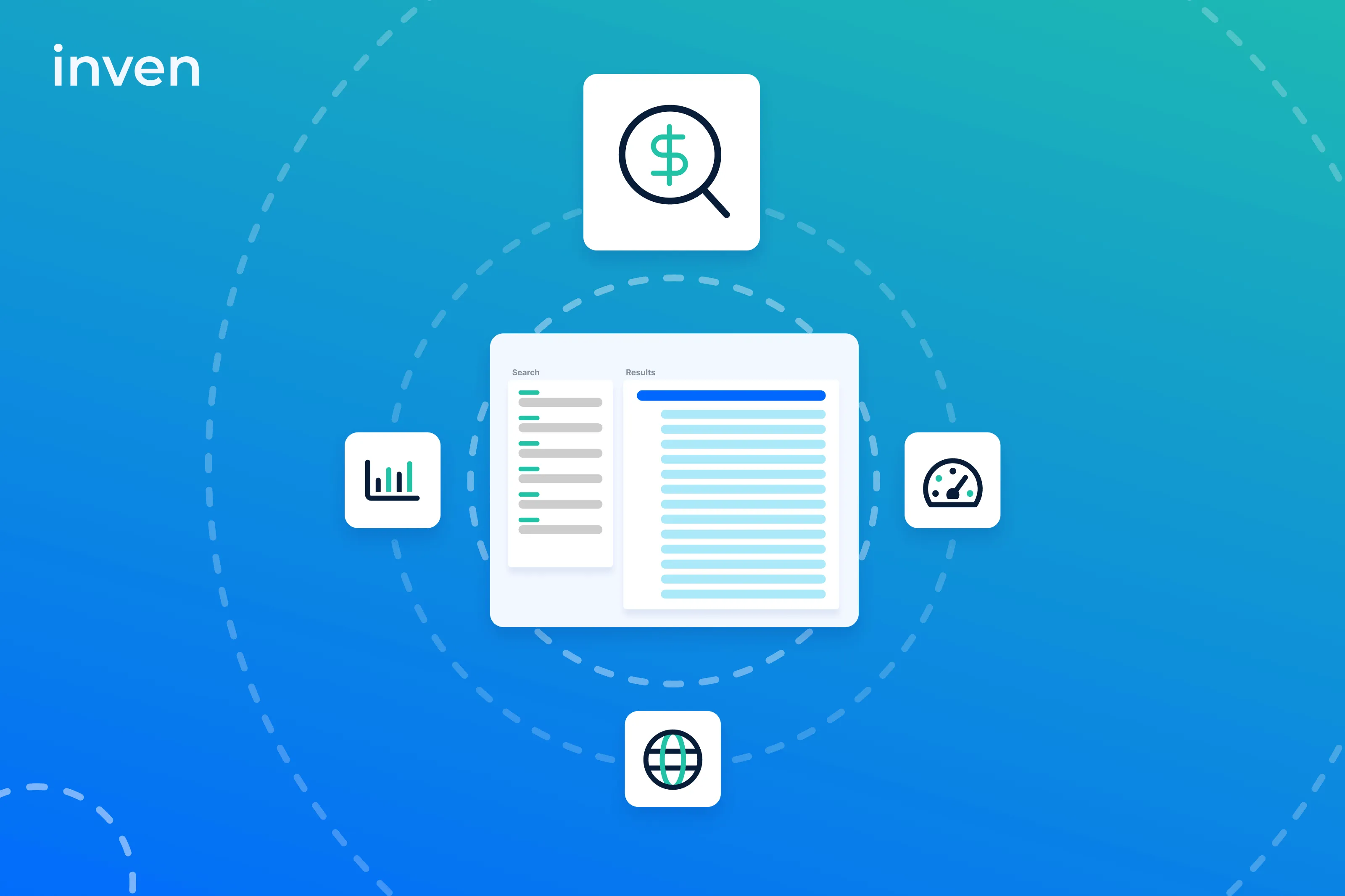

The best AI tools for PE research in 2026 are Inven, PitchBook, Capital IQ Pro, CB Insights, and diligence tools like Kira and Evisort. Inven produces one-pagers and overview slides in the firm's PowerPoint template.
Last updated August 2026.
The best AI tools for private equity research in 2026 are Inven, PitchBook, S&P Capital IQ Pro, CB Insights, and specialist diligence tools such as Kira and Evisort. Inven generates the PowerPoint materials a deal team actually presents, one-pagers and overview slides built in the firm's own template, along with saved M&A workflows for longlists, market maps, comps, and watchlist refreshes, all drawn from data Inven itself owns on 28M+ companies. PitchBook and Capital IQ remain the reference for deals and comps, CB Insights covers innovation landscapes, and Kira and Evisort read the contracts once a name is in the funnel.
Where firms have published results, they are concrete. Lexar Partners builds target and buyer lists ten times faster than before, in 15–30 minutes instead of days. Daniel Khazzam describes the working experience directly:
"We really enjoy using Inven — it's easy to quickly generate a high-quality target list in a given sector. The business we acquired came directly from Inven."
Which AI tool fits which PE research job?
Six names carry the core stack, and each earns its place by doing a different job.
| Tool | What it is strong at | When it fits |
|---|---|---|
| Inven | One-pagers and overview slides in your firm's PowerPoint template, plus saved M&A workflows (longlists, market maps, comps, watchlist refreshes) from Inven's own data on 28M+ companies (Inven product data, August 2026) | When the thesis calls for finished materials in the house format rather than raw search results |
| PitchBook | Deal histories, sponsor activity, and fund data | Validating transactions and investors on names you already have |
| S&P Capital IQ Pro | Filings, comps, and screening with modeling workflows | Public comps and the models that follow the research |
| CB Insights | Startups, emerging technology, and market trends | Innovation and venture-backed landscapes |
| SourceScrub | US coverage from events and directories; acquired by Datasite in August 2025 | Conference and directory-driven US lists |
| Kira / Evisort | AI contract review and document analysis | Diligence, after a name is in the funnel |
Inven
Inven's job in the PE stack is producing the materials. An associate writes the thesis once as a plain-English brief covering geography, ownership, size, and what a good add-on looks like, and Inven returns the output already formatted: longlists and market maps built as saved workflows, and one-pagers and overview slides generated in the firm's own PowerPoint template. Everything draws on data Inven collects and maintains itself on 28M+ companies, with 430M+ professional and owner contacts attached to the records. Because the data is native rather than licensed from PitchBook, Capital IQ, or FactSet feeds, the output holds up on founder-owned lower-middle-market companies that the licensed datasets cover thinly. Because the workflows are saved, the next associate can rerun the same brief on the next platform instead of rebuilding the screen from scratch. Custom columns and fit scoring run through the AI Screener, and more than 1,000 investment banks, private equity firms, consultancies, and corporate development teams use Inven (Inven, August 2026).
Inven does not replace the rest of the stack. Keep PitchBook and Capital IQ for deals and comps, and Kira or Evisort for the contract work once a target is real. Inven is not the world's best contact-data provider. For that, there are better tools. More on the PE workflows is at Inven for private equity, or book a demo to run a live thesis in your own template.
PitchBook
PitchBook is the transaction reference. It carries deal histories, sponsors, valuations, and fund data, and in a PE stack its role is validation: who has bought in the space, at what marks, and backed by which funds. It is not built to surface companies that have never transacted, which is where most add-on universes live.
S&P Capital IQ Pro
Capital IQ Pro carries filings, comps, and screening, along with the modeling workflows that follow the research. It stays in the stack for the comps and the models. Below the disclosed tier, its coverage thins out.
CB Insights
CB Insights covers startups, emerging technology, and market trends. When the landscape in question is an innovation or venture-backed one, it is the right lens. For established private operators in traditional verticals, its coverage points the wrong way.
SourceScrub
SourceScrub compiles 15M+ companies from events, directories, and networks, with a bias toward US founder-owned businesses. Datasite acquired it in August 2025, two months after acquiring Grata in June 2025, and is now integrating the two. SourceScrub supplies coverage as an input. It does not produce presentation-ready materials.
Kira and Evisort
Kira and Evisort apply AI to contract review and document analysis, covering extraction, clause comparison, and obligations. They earn their place in diligence, after a name is in the funnel, and they save associate weeks there. Building the funnel itself is not their job.
AI tools for deal sourcing
The sourcing family overlaps the core stack: Inven, PitchBook, Dealroom, and SourceScrub. Inven's contribution is the materials the sourcing process runs on, meaning the longlists, market maps, and company pages produced as saved workflows from its own data. PitchBook contributes the deal tape, Dealroom covers venture and technology ecosystems, and SourceScrub brings US event-driven coverage inside Datasite. Most firms run two of these, not one.
AI tools for market intelligence
CB Insights, Kensho, and Capital IQ Pro form the intelligence layer: innovation landscapes, AI-driven analytics on market data, and the filings-and-estimates picture. They are strongest once the subject is already defined. They feed the analysis rather than producing the deal team's presentation materials.
AI tools for due diligence
Kira and Evisort read the documents. DataRobot and Alteryx work the data, running automated modeling and analytics pipelines on the target's numbers. All four operate on material the process has already produced. They compress diligence rather than sourcing it, and nothing in the sourcing stack replaces them.
AI tools for portfolio monitoring
ZBrain builds AI workflows over a firm's own portfolio data, Nosible tracks a universe of 32,000 companies and 45,000 funds for monitoring and benchmarking, and ROIC.ai covers fundamentals for watching public markets. This family looks after what the fund already owns, which is a different job from research and runs on different data.
AI tools for communications
InboxPro and Outboundly apply AI to the outreach layer: drafting, sequencing, and keeping founder conversations moving. They save real hours, with one clear limit. They work on the communication about the deal, not on the research behind it.
AI tools for slide decks
SlideInstantly and SlideGPT generate and polish general-purpose slides quickly. The distinction worth keeping straight is that they format content you hand them, while Inven generates the one-pagers and overview profiles in the firm's own PowerPoint template with sourced data behind every field. Decorating a blank deck and producing the finished page are different jobs.
How should PE firms choose AI tools?
Four questions sort almost every vendor. Does the tool own its data, or is it an interface over feeds you could license directly? Does its coverage reach the founder-owned lower middle market where your theses actually live? Does it hand you finished materials in your format, or a search result you still have to assemble? And does the work repeat, so that the next associate can rerun the same workflow on the next thesis instead of starting every mandate from scratch?
Answered honestly, those questions sort the stack the way this article does: Inven for the PowerPoint materials and saved workflows built on data it owns, the terminals for deals and comps, CB Insights for innovation, and the specialists for diligence, portfolio, and outreach. More than 1,000 M&A teams run Inven for that end of the stack (Inven, August 2026). Book a demo and bring a live thesis. The fastest real test is watching the longlist, the map, and the slides come out in your own template.
See the full private market
1,000+ M&A teams use Inven to find the companies others miss.
Join 1,000+ M&A teams using Inven analyze entire markets and build polished deliverables — backed by private market data.
Frequently asked questions
What are the best AI tools for private equity?
For research: Inven, PitchBook, Capital IQ Pro, and CB Insights. Around them sit SourceScrub and Dealroom for coverage inputs, Kira and Evisort for contract diligence, DataRobot and Alteryx for data work, ZBrain, Nosible, and ROIC.ai for portfolio monitoring, and the outreach and slide tools at the edges. No single tool covers the whole stack.
When should a PE firm use Inven?
When the thesis needs finished materials: one-pagers and overview slides generated in the firm's own PowerPoint template, plus longlists, market maps, comps, and watchlist refreshes run as saved workflows from data Inven owns on 28M+ companies. Keep the terminals for deals and comps and the diligence tools for the funnel. Inven's job is the materials, and it does not replace either.
Can Inven produce IC materials?
It produces the parts: one-pagers and overview slides in the firm's own template, plus the longlist and market map behind them, with sourced data on every field. Inven is not the world's best contact-data provider. For that, there are better tools.
Is Rogo an alternative to Inven?
They are two jobs, not a swap. Rogo is a finance agent that answers questions over the licenses a firm already pays for plus its own files. It is not a sourcing graph, and nothing here suggests ripping it out. Inven generates PowerPoint materials and saved workflows from data it owns, and it does not replace Rogo's finance agent, the Excel model work around it, or a tool like Model ML's Notetaker. Firms that feel both gaps run both.
Do diligence tools overlap with research tools?
No. They sit at opposite ends of the funnel. Kira, Evisort, DataRobot, and Alteryx work on documents and data the process has already produced on a known target. The research stack produces the universe and the materials upstream of that. A firm needs both ends, and neither substitutes for the other.
Lorem ipsum dolor sit amet, consectetur adipiscing elit, sed do eiusmod tempor incididunt ut labore et dolore magna aliqua. Ut enim ad minim veniam, quis nostrud exercitation ullamco laboris nisi ut aliquip ex ea commodo consequat. Duis aute irure dolor in reprehenderit in voluptate velit esse cillum dolore eu fugiat nulla pariatur.