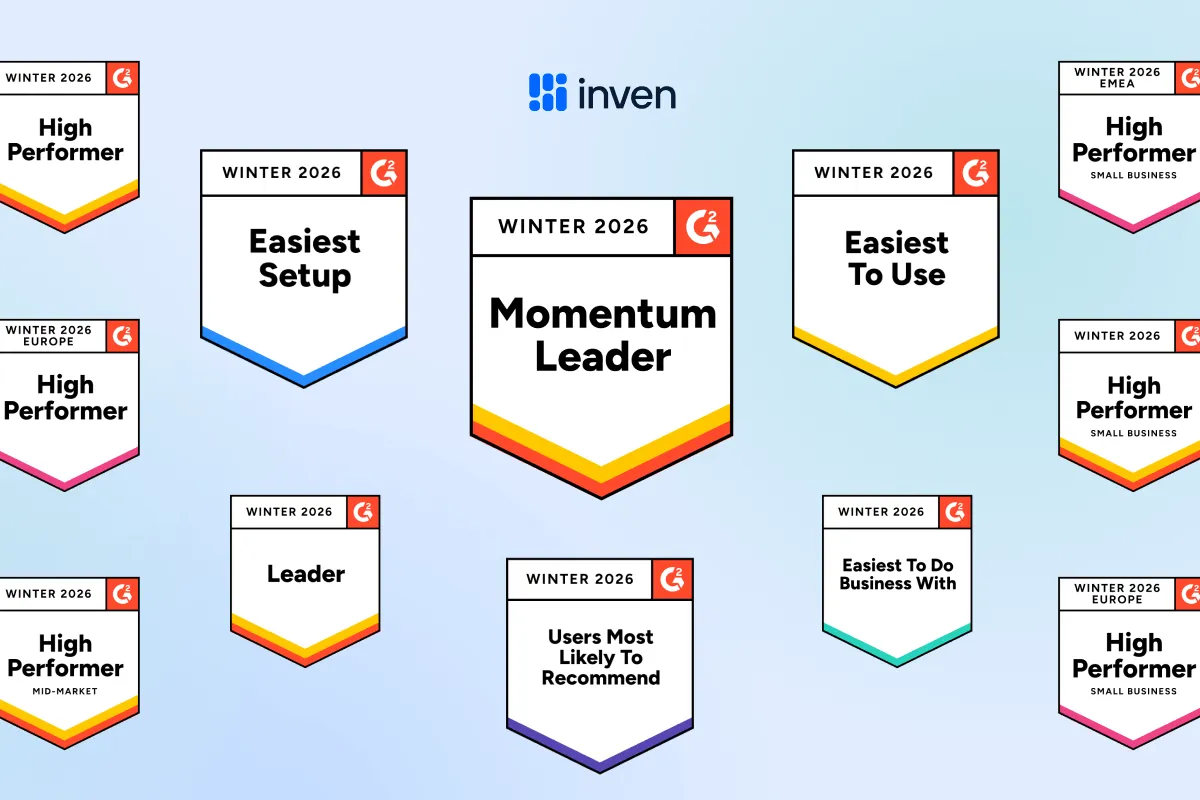

Inven, ChatGPT, Claude, Gemini, PitchBook, and Grata are the AI tools M&A teams use in 2026. Inven maps 28M+ private companies. ChatGPT, Claude, and Gemini draft and synthesize. PitchBook covers transactions. Grata is a second source of middle-market names.
Last updated August 2026.
AI has moved into the research layer of deal work. In 2026, the tools M&A teams actually use are Inven, ChatGPT, Claude, Gemini, PitchBook, and Grata, and each does a different job. Inven maps 28M+ private companies and turns a brief into a longlist or a market map. ChatGPT, Claude, and Gemini draft and synthesize. PitchBook covers transactions. Grata is a second source of middle-market names. Risto Siilasmaa's view on how to adopt all of this sits further down the page.
The practical effect is simple: the hours a team used to spend finding, screening, and writing up private companies now compress into minutes, and the judgment calls that follow get more of the team's attention. The assistants handle the writing. Inven holds the company universe.
For ten concrete sourcing use cases, see AI for M&A deal sourcing. For off-market origination, see How to generate proprietary deal flow with AI.
What are the best AI tools for M&A research?
Six tools cover the field, and they complement each other rather than compete. Inven maps private markets across 28M+ companies (Inven product data, August 2026) and returns a longlist or market map from a plain-language brief. ChatGPT, Claude, and Gemini are writing and reasoning engines. PitchBook is where you go for transactions. Grata offers another pool of middle-market names.
| Tool | Research job | When it fits |
|---|---|---|
| Inven | Maps 28M+ companies from a brief to a longlist or market map | Finding and screening private companies |
| ChatGPT | General-purpose writing and synthesis | CIMs, theses, and brainstorming, not a company database |
| Claude | General-purpose writing; can connect to Inven data | Teams that already work in Claude |
| Gemini | General-purpose writing and synthesis | The same writing job as ChatGPT, without Inven data |
| PitchBook | Transaction, valuation, and investor data | Deal comps and sponsors |
| Grata | Middle-market web-data discovery (now Datasite) | A second name source, not the full research workflow |
The assistants earn their place summarizing CIMs, sharpening investment theses, brainstorming search strategies, and interpreting financials. What they cannot do on their own is hold a reliable universe of private companies. Ask ChatGPT for every industrial services roll-up candidate in Bavaria and you get plausible prose, not a verifiable list. Claude narrows that gap because it can connect directly to Inven's data; see How Inven works with Claude.
The specialists have their own limits. PitchBook was not built to map a fragmented lower-middle-market vertical from scratch, and Grata's coverage and financial depth stop short of a full private-market map.
Working with Inven feels less like querying a database and more like briefing a colleague: describe the kind of company you want, and the screen comes back as a longlist or a market map. 1,000+ investment banks, private equity firms, consultancies, and corporate development teams use Inven (Inven, August 2026), and several firms, including Edgehill Management, Augusta Advisors, and Desert Horizon Capital, sourced real deals directly through it.
What did Risto Siilasmaa say about the future of AI in M&A?
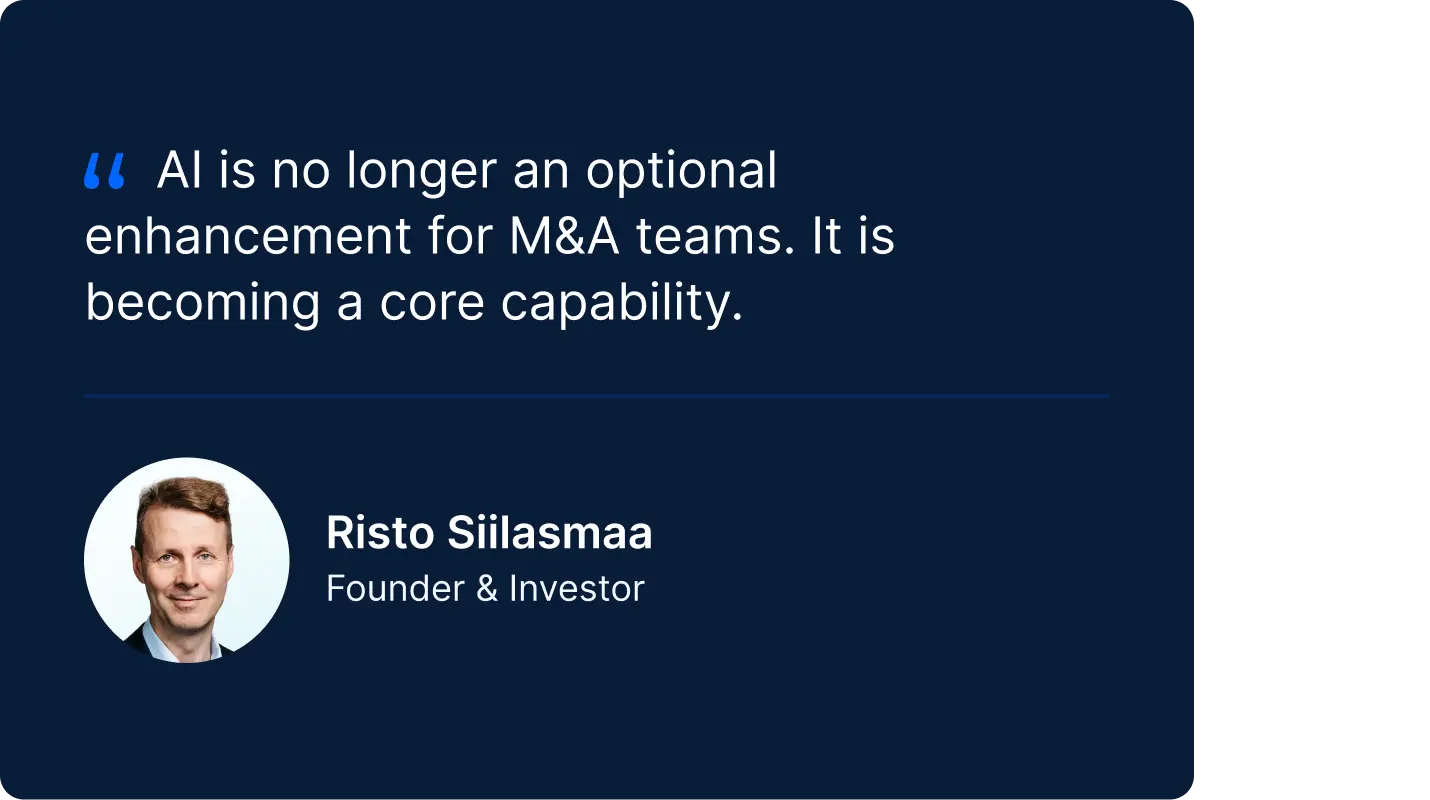
Risto Siilasmaa's argument is that AI is no longer optional for M&A teams: it is becoming a core capability. The traditional workflow of manual research, fragmented data, and slow list building is exactly the kind of work AI absorbs well, but he was equally clear about the limit: AI should augment judgment, not replace it. Firms that adopt early, he argued, will move faster and find more opportunities than teams still running the old process.
Siilasmaa speaks from an unusual vantage point. He is the founder of WithSecure, a longtime board member, and an active investor, so he has seen the acquirer's side, the board's side, and the target's side of deals. This article draws on his remarks from a recent webinar and connects them with what 1,000+ M&A teams already using Inven have learned in practice.
How are M&A teams using AI to avoid missing high-quality targets?
Three ways: they surface companies that never appear in traditional searches, they read what a company actually does rather than trusting its industry code, and they cut the hours spent on research they were already doing. The numbers behind those claims are on this page: analysts report 30% more targets, Lexar Partners builds lists in 15–30 minutes, Crossroads Capital cut its search process by up to 80%, and Village Wellth saved 50–70% of research time.
The costliest miss in sourcing is the silent one: the company that should have been on your radar and simply never showed up.
1. Discover companies before competitors see them
Emerging companies in niche verticals often surface through AI months before they appear on conference lists or in databases, which means a team can open a conversation before an auction forms. Analysts report finding 30% more targets compared to traditional tools.
2. Understand what a company actually does, not just its industry code
Industry codes flatten companies into categories that were never designed for deal work. AI reads the company's own signals instead: its website, its job posts, its digital footprint. That distinction matters most exactly where the codes fail, in IT services, healthcare niches, and software subcategories.
3. Cut research time on work teams already do
The gains here are documented, not hypothetical. Lexar Partners cut list building from a full day to 15–30 minutes. Crossroads Capital reduced their search process by up to 80%. Village Wellth saved 50–70% of research time per search. Every hour not spent crawling the web is an hour spent evaluating fit and building relationships, which is where deals actually get won.
Why is AI becoming essential for investment banks, PE firms, and corporate development teams?
Because each of these groups has a specific research bottleneck that AI genuinely relieves: buyer and target lists for banks, add-on and family-owned sourcing for private equity, and multilingual market scans for corporate development. Siilasmaa framed the broader shift well: mid-market teams now have analytical reach that used to belong only to the largest acquirers.
Investment banking
For a bank, the bottleneck is list assembly under time pressure. AI builds buyer and target lists in minutes, flags retirement-aged founders and intent signals, and validates market maps before they go in front of a client. Analysts describe AI-based searches as feeling "like scraping the entire internet".
Private equity
For PE, the problem is crowding. Every fund fishes in the same intermediated pools, so the edge goes to whoever sources outside them. AI helps firms find add-on and platform opportunities, reach family-owned businesses that never enter a process, and several PE teams report finding companies with AI that do not appear in Grata, PitchBook, or traditional databases.
Corporate development
Corp dev teams scan the widest terrain with the smallest headcount: global markets, multiple languages, niche technical capabilities, segments that reshape themselves quarterly. AI makes that scan feasible for a team of two or three. As Siilasmaa noted, AI levels the playing field.
What workflows benefit the most from AI in deal sourcing?
Four of them: market mapping, target screening, prioritization, and cross-border discovery. In each case AI fills the list and humans still decide on fit and own the relationships.
1. Market mapping
Instead of starting from an empty spreadsheet, a team can ask for a view of a niche and get one, whether the brief is "Microsoft Dynamics integrators in the Nordics" or "medical equipment distributors with >20% headcount growth."
2. Target screening
Screening used to mean opening a hundred websites one at a time. AI evaluates the same signals at once: website content, hiring momentum, ownership structure, geographic footprint, digital activity. M&A professionals often describe this as having "a team of junior researchers working underneath you."
3. Prioritization
A longlist is only useful once it is ranked. AI highlights the companies most worth a call first: likely founder-owned, nearing a generational transition, showing intent-to-sell indicators, or visibly gaining or losing traction.
4. Cross-border discovery
Because AI processes multilingual content, a team can evaluate the German Mittelstand or Japanese suppliers without being limited to English-only datasets or hiring local researchers first.
How can M&A teams start adopting AI effectively?
Start by pointing AI at the list-building and filtering you already do, choose a tool your analysts will actually open, keep human judgment in the loop, and treat the first months as iteration rather than rollout. Siilasmaa's frame applies throughout: augment, don't replace.
1. Start small. Put AI on work you already do
The fastest path to conviction is applying AI to a search your team ran manually last quarter and comparing the results. No new process, no transformation program, just the same work done faster.
2. Don't overcomplicate tool choice
Ease of use matters more than sophistication. A tool an analyst reaches for every morning beats a more powerful one that requires training nobody schedules.
3. Combine human judgment with AI speed
AI handles breadth; humans handle nuance. The machine can tell you a founder is approaching retirement age. It cannot build the trust that gets that founder to take your call. Relationships cannot be automated, and nobody serious is trying.
4. Focus on iteration
The teams that see the biggest gains treat AI as a feedback loop rather than a one-time setup: refining search criteria, reshaping theses, and discovering new sub-verticals week after week.
What does the future look like for AI-driven M&A?
Three shifts are already visible: deal cycles compress as research time collapses, more off-market opportunities surface as overlooked segments become searchable, and boards raise their expectations for analytical depth. The open question is no longer whether AI reshapes M&A. It is which teams adapt in time.
1. Faster deal cycles
When the research phase shrinks from weeks to days, everything downstream moves up. Teams that once evaluated a handful of opportunities per quarter can work through several times that volume with the same people.
2. More off-market opportunities
Segments nobody had time to map are now a brief away, which means more first conversations happening outside competitive processes, before a banker has built the book.
3. Higher expectations for analytical depth
Boards and investment committees will soon expect AI-enhanced analysis as the norm. "We looked at the usual names" will read as an admission, not a method.
Where Inven fits in all of this: it generates the deliverables directly, company one-pagers and overview slides built in your firm's own PowerPoint template, alongside saved M&A workflows that run on data Inven owns across 28M+ companies. That data is native, built for private-market work, not a licensed PitchBook, CIQ, or FactSet feed dressed up with a chat window. Join the 1,000+ M&A teams already mapping markets with it. Book a demo.
See the full private market
1,000+ M&A teams use Inven to find the companies others miss.
Join 1,000+ M&A teams using Inven analyze entire markets and build polished deliverables — backed by private market data.
Frequently asked questions
What are the best AI tools for M&A research?
There is no single best tool, because the jobs differ. If the task is finding and screening private companies, start with Inven. If it is drafting, summarizing, or thinking through a thesis, use ChatGPT, Claude, or Gemini. For transaction comps and sponsor data, PitchBook. For a second opinion on middle-market names, Grata. Most teams end up running two or three of these side by side.
Does Inven replace ChatGPT or Claude?
No, and it is not meant to. Inven answers "which companies exist and match my brief"; the assistants answer "help me write and reason about them." The two layers work best together, and Claude can plug directly into Inven's data, so a team can query the company universe from inside the assistant it already uses.
What did Risto Siilasmaa say about AI in M&A?
That it has crossed from advantage to requirement. In his framing, AI is becoming a core capability for deal teams, and the firms that adopt it early will out-source and out-pace the ones that wait. His caveat is the part worth remembering: the point is to augment judgment, not replace it. The machine widens the funnel; people still decide what belongs in it.
When should a team choose PitchBook or Grata instead of Inven?
Choose PitchBook when the question is about deals rather than companies: who transacted, at what valuation, with which sponsors. Choose Grata (now part of Datasite) when you want an additional pool of middle-market names to cross-check. When the question is "map this fragmented private market for me," that is Inven's job, and the others were not built for it.
Do you need Claude to use Inven?
No. Inven is a standalone platform: you describe the companies you want in plain language and work from the resulting longlist, market map, or generated slides. The Claude connection is an option for teams that prefer to reach Inven's data from inside Claude, not a prerequisite.
Lorem ipsum dolor sit amet, consectetur adipiscing elit, sed do eiusmod tempor incididunt ut labore et dolore magna aliqua. Ut enim ad minim veniam, quis nostrud exercitation ullamco laboris nisi ut aliquip ex ea commodo consequat. Duis aute irure dolor in reprehenderit in voluptate velit esse cillum dolore eu fugiat nulla pariatur.
%20(1)-2.jpg)