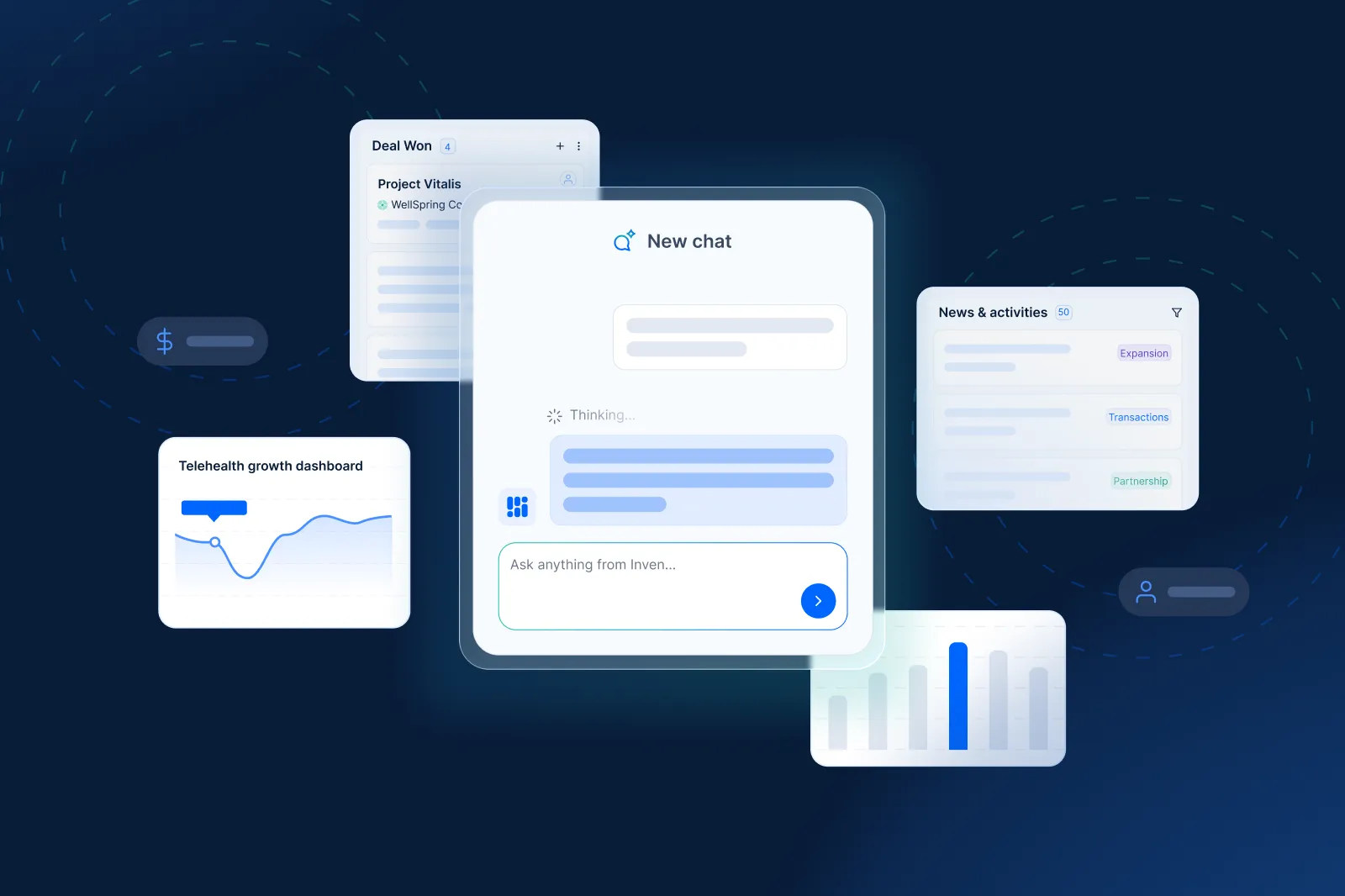

Inven, PitchBook, Capital IQ, and Grata are the CDD tools M&A teams use in 2026. Inven builds the market; the others hold deals and filings.
Last updated August 2026.
Inven, PitchBook, Capital IQ, and Grata are the tools M&A teams use for commercial due diligence in 2026. Inven builds the market, competitor, and buyer picture and turns it into slides. PitchBook and Capital IQ hold transaction data and public-company financials. Grata is middle-market company discovery from web data. In practice, consultants use Inven to assemble the commercial fact base first, then bring in interviews and pricing work on top of it.
It helps to be clear about what commercial due diligence actually covers. CDD tests a target's market, its competitors, its buyers, and its commercial risks before a transaction closes. A virtual data room shares documents, and an expert network arranges interviews. Both matter, but neither builds the market universe that the rest of the CDD work depends on.
If you want a broader category ranking, our roundup of the best platforms for deal sourcing covers the adjacent tool landscape.
Where each of the four tools fits
None of these four products replaces the others, which is why most teams run at least two. Inven covers the market side: who operates in the space, who competes with whom, who might buy, and whether the market is concentrated or fragmented. PitchBook and Capital IQ cover the financial side: recorded deals, valuations, public comps, and analyst estimates. Grata generates lower- and middle-market names from web data. Pair a coverage product with a financials source and you have the raw material for most CDD workstreams.
| Tool | Role in commercial due diligence | When it fits |
|---|---|---|
| Inven | Builds the market universe, competitor set, substitutes, buyers, and fragmentation view from what companies actually do, across 28M+ companies (Inven product data, August 2026) | Consultants and deal teams who need complete commercial coverage before interviews |
| PitchBook | Transaction, valuation, and investor data used to sanity-check commercial conclusions | Deal comps and sponsor activity next to the market map |
| Capital IQ | Public-company financials, estimates, and analyst research | Public comps and market reports |
| Grata | Middle-market company discovery from web data (now part of Datasite) | Lower- and middle-market name generation |
To place Inven precisely: it is not a virtual data room and not an expert network. It owns its data on 28M+ companies rather than licensing PitchBook, Capital IQ, or FactSet feeds, and its output is working material, not raw records. It generates company one-pagers and market overview slides in your firm's own template, and it saves the recurring M&A workflows, such as market maps, competitor sets, and buyer lists, so they can be rerun as the thesis evolves. Keep PitchBook or Capital IQ alongside it for recorded deals and public financials, and keep your VDR for diligence files.
What software supports commercial due diligence?
Commercial due diligence, as KPMG defines it, validates a company's market, competitive position, and commercial risks before a transaction. The software that supports it does the groundwork: building coverage of a market and its participants, identifying competitors and buyers, and checking assumptions as the deal progresses. Investment banks, private equity firms, corporate development teams, and consultancies all run some version of this stack.
The way teams use these tools has shifted. A static market report written at the start of a project goes stale by the second week of fieldwork, so deal teams now expect searchable coverage they can requery as the thesis changes. That means being able to rebuild the participant list when the scope moves, test fragmentation and growth assumptions against actual company counts, and widen or narrow the competitor set without starting the research over.
Why do teams use Inven for commercial due diligence?
Because Inven produces the working material a CDD team spends most of its time on: company one-pagers and market overview slides generated directly in the firm's own template, backed by saved M&A workflows for market maps, competitor sets, and buyer lists. The data underneath is Inven's own, covering 28M+ companies, rather than a relicensed PitchBook, Capital IQ, or FactSet feed, so the coverage extends into private markets those databases treat thinly.
Founded in 2022, Inven maps private markets with proprietary data on 28M+ companies, and 1,000+ investment banks, private equity firms, consultancies, and corporate development teams use it (Inven, August 2026). The workflow is the same one described in our piece on market mapping: a CDD brief goes in, and a market map, competitor set, or buyer list comes out, ready to drop into the deck.
One honest limit is worth stating up front, because it matters more in CDD than anywhere else. Inven is not the world's best contact-data provider. For that, there are better tools. The interviews, the pricing studies, and the narrative that ties a CDD report together remain the consultant's work.
How do commercial due diligence teams use Inven?
The sequence usually runs: define the market, map competitors and substitutes, measure fragmentation, list buyers, and keep the picture current after signing. At each step the output can land as a one-pager or as overview slides in the firm's template, which is where much of the time saving actually shows up.
Market and scope definition
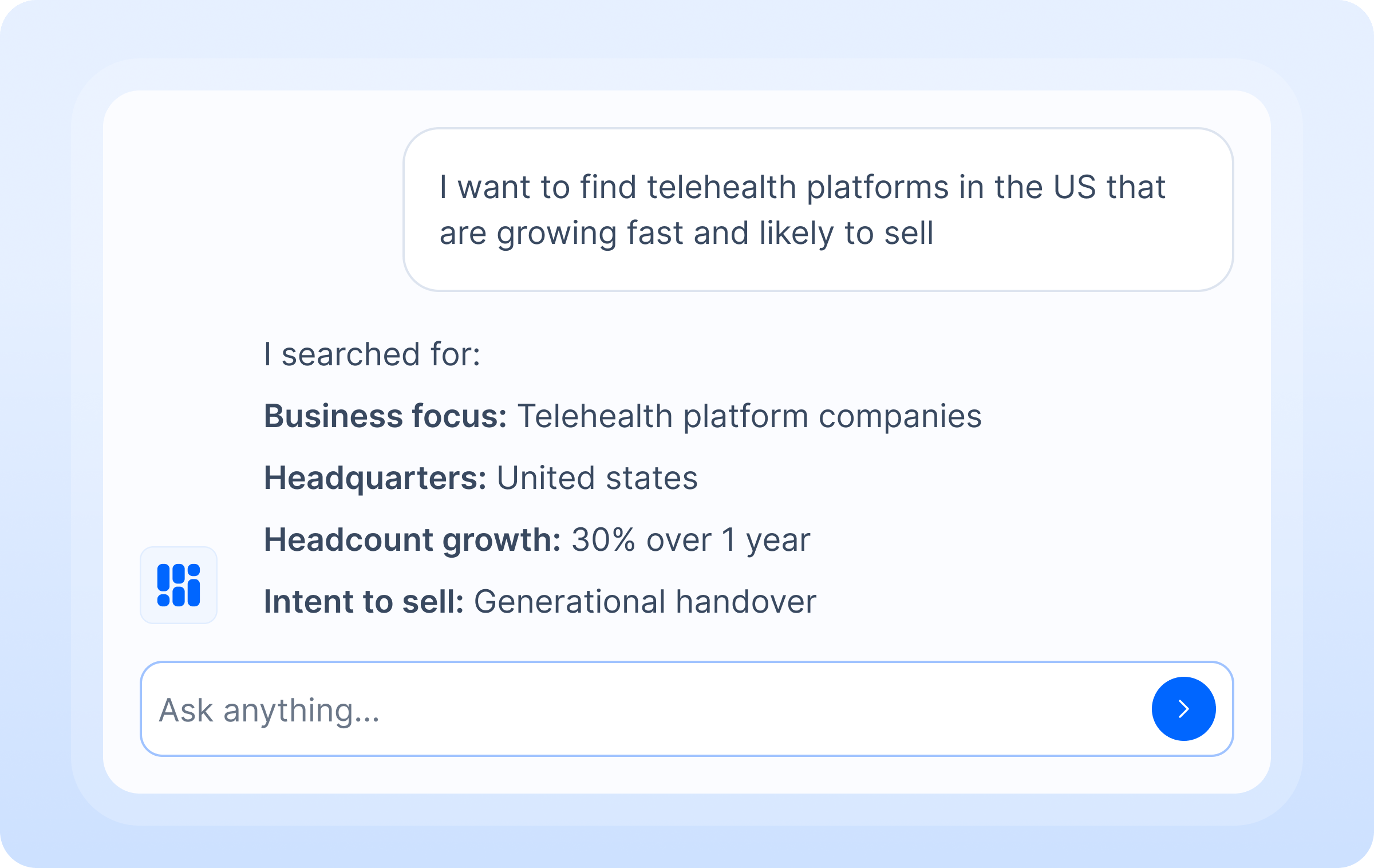
The first question in any CDD workstream is what the market actually contains. Teams describe the market in natural language or hand Inven a few example companies, and it returns businesses that genuinely operate in the space, judged by what they do rather than by their industry classification codes. Classification codes are the usual failure point here: they are coarse, inconsistently applied, and nearly useless across borders, which is why this approach earns its keep in niche sectors, fragmented markets, and cross-border scopes.
Competitor, substitute, and adjacency analysis
Once the universe exists, the competitive analysis becomes iterative rather than one-shot. An analyst can pull direct and indirect competitors, add substitutes, and strip out noise with negative keywords, then compare the remaining set by size, geography, ownership, and business focus. When an interview or a client conversation shifts the hypothesis, the set gets requeried in minutes instead of rebuilt from scratch.
Fragmentation and consolidation assessment
Many CDD theses stand or fall on a counting question: how many relevant companies exist, and who owns them? Inven puts numbers on it. Teams see how participants distribute by scale and ownership, whether consolidation is already underway, and what historical M&A in the space says about how buyers have behaved. For a buy-and-build thesis, this is often the single most load-bearing slide in the commercial section.
Buyer and investor analysis in commercial due diligence
Exit and demand-side questions come next. Teams identify strategic buyers active in the space, review private equity firms' investment histories, and flag PE-backed companies that could act as platforms. Prioritization rests on demonstrated activity and fit, meaning who has actually bought or invested in comparable businesses, not who plausibly might.
Supporting commercial due diligence consultants
Inven does not conduct interviews, run pricing studies, or write the report, and it is not trying to. What it changes is where a consulting team's hours go. When the market and competitor fact base arrives as ready slides in the firm's template, the team spends its time on the parts of CDD that require judgment: talking to customers, testing pricing, and building the argument. The narrative stays with the consultants; the assembly work largely does not.
Commercial due diligence beyond the transaction
The market view built during diligence keeps earning after signing. Because the underlying searches are saved workflows rather than one-off exports, teams rerun them to monitor competitors and new entrants, track how consolidation is progressing, and surface add-on, partnership, and expansion candidates as the portfolio company executes its plan.
What do teams achieve with Inven in commercial due diligence?
Faster CDD cycles, mainly because the market map and competitor slides that used to take days of manual research now come out of the platform, and more complete coverage in the markets where research is hardest: niche, fragmented, and cross-border. Teams reach a confident view on the thesis earlier in the engagement, which is when that confidence is worth the most. 1,000+ teams work this way today (Inven, August 2026).
How does Inven strengthen the CDD fact base?
By generating the commercial layer of a CDD workstream as finished working material: company one-pagers and market overview slides in your firm's own template, plus saved market maps, competitor sets, and buyer lists built on data Inven owns across 28M+ companies. It will not write your CDD report, and the interviews and pricing work stay with your team. But the slides and analyses that make up the commercial fact base come out faster and rest on broader private-market coverage than licensed-feed tools provide.
Book a demo to see it on a market you know.
See the full private market
1,000+ M&A teams use Inven to find the companies others miss.
Join 1,000+ M&A teams using Inven to map markets faster, find the companies others miss, and build defensible outputs across 28M+ companies.
Frequently asked questions
What are the best commercial due diligence software tools for M&A teams?
For most teams, the practical answer is a pairing: Inven for market, competitor, and buyer coverage, plus either PitchBook or Capital IQ for deals and financials. Choose PitchBook if sponsor activity and private transaction comps matter most, Capital IQ if your work leans on public comps and analyst research. Grata is worth adding when lower-middle-market name generation is the bottleneck, particularly for teams already inside the Datasite ecosystem.
When should teams use commercial due diligence software?
Before the fieldwork starts, not after. The market universe should exist ahead of the first customer interview, because the interview list, the competitor questions, and the pricing hypotheses all depend on it. The tools also pay off at the two edges of the process: early red-flag or pre-LOI screening, where a quick fragmentation view can kill a weak thesis cheaply, and post-signing, where the same searches become monitoring.
How does Inven support commercial due diligence?
It delivers specific pieces of the CDD deck rather than the deck itself: one-pagers and overview slides generated in your firm's template, and saved workflows for market maps, competitor sets, and buyer lists, all built on Inven's own data covering 28M+ companies (Inven product data, August 2026). A full CDD report still needs interviews, pricing analysis, and a consultant to write the story. Inven shortens everything around those steps.
What types of deals benefit most from commercial due diligence software?
Deals where the market is hard to see from a desk. Niche B2B sectors, fragmented services markets, buy-and-build platforms that need a reliable count of add-on candidates, and cross-border transactions where industry classifications break down all fit that description. A large public target already covered by a dozen analysts benefits less; there, Capital IQ carries more of the load and the coverage tools matter mainly for adjacencies.
How do I know if Inven is right for my team?
Ask how your last commercial workstream was built. If analysts spent days assembling market maps, competitor slides, or buyer lists by hand in PowerPoint, and your work touches private companies, Inven will pull that time out of the process. If what you actually need is a data room, expert calls, or public-market financials, look elsewhere first. The fastest way to decide is to book a demo and run a market your team has already mapped manually, then compare.
Lorem ipsum dolor sit amet, consectetur adipiscing elit, sed do eiusmod tempor incididunt ut labore et dolore magna aliqua. Ut enim ad minim veniam, quis nostrud exercitation ullamco laboris nisi ut aliquip ex ea commodo consequat. Duis aute irure dolor in reprehenderit in voluptate velit esse cillum dolore eu fugiat nulla pariatur.
%20(1)-2.jpg)